Treadmill Comparisons
Thermal Management Systems Compared: Cooling Efficiency & Design
10th May•13 min read
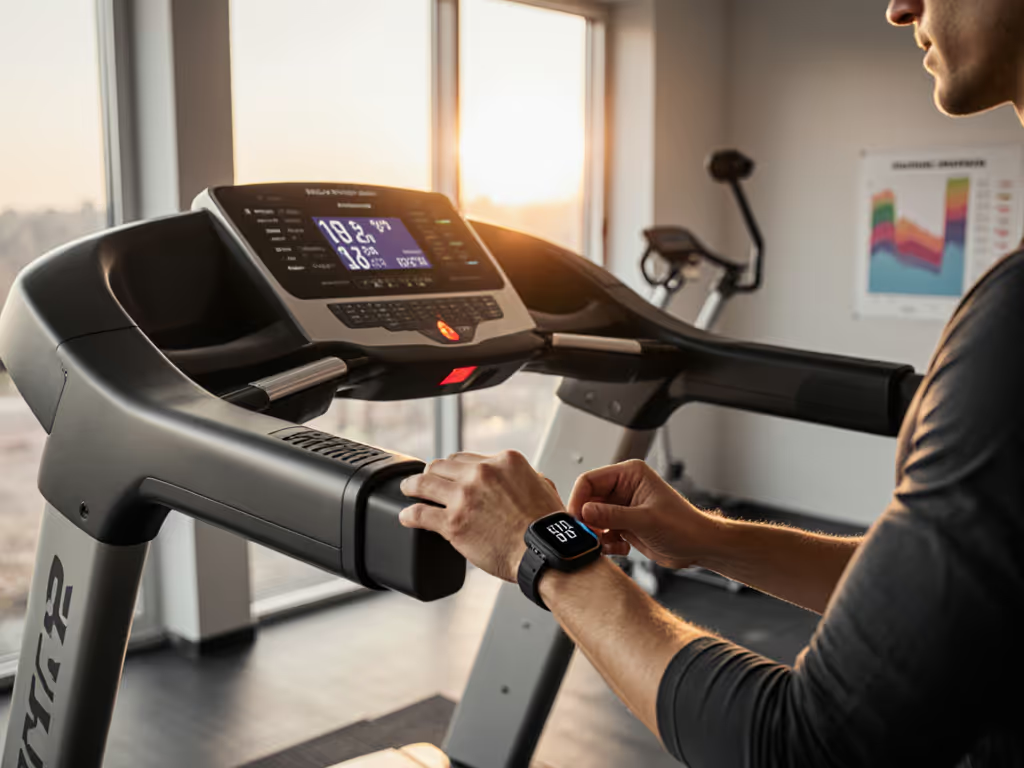
When you're counting on your treadmill heart rate accuracy to stay in your training zone, you deserve to know which monitor type delivers reliable data. Forget marketing claims, let's examine the real-world performance in this built-in heart rate monitor comparison. Understanding what works (and what doesn't) saves you from wasting workouts and potentially overexerting yourself.
Heart rate isn't just a number, it's your body's feedback system. When you're using heart rate zone training to lose weight, build endurance, or recover from injury, inaccurate readings can derail your entire program. Too low? You're wasting time. Too high? You're risking injury or burnout. I've seen countless clients frustrated because their treadmill told them they were in fat-burning zone when they were actually barely breaking a sweat. For foundational context, see our treadmill running for heart health guide.
That's why I left my mobile tech job to write these guides. You shouldn't need an engineering degree to trust your equipment. As I tell every client: Preventive care beats warranty claims nine days out of ten. Five minutes of proper setup beats hours of frustrated guessing.
Treadmill pulse grip effectiveness depends entirely on consistent skin contact. These hand sensors use electrical impedance (measuring the tiny resistance as blood pumps through your fingers). Meanwhile, chest straps use electrocardiogram (ECG) technology that detects your heart's actual electrical activity, just like hospital equipment.
Here's what most marketing materials won't tell you: Grip sensors work best when you're standing perfectly still with dry hands. But treadmills? They're moving platforms where your grip naturally shifts as you run. I've seen more than one client develop "white knuckle syndrome" trying to maintain constant contact, and still getting erratic readings.
Let's cut through the noise with actual research:
Bench Tests vs. Real Movement: When tested statically, most monitors show errors under 3 BPM. But once you start moving? Studies show 20-70% of grip sensor readings can be off by more than 20 BPM during light jogging! (Source: Burke & Whelan, Journal of Sports Medicine)
Chest Strap Reliability: ECG-based chest straps maintain accuracy within 2-5 BPM even during intense running. They're the standard used in clinical treadmill stress tests for good reason.
The Sweat Factor: Grip sensors become increasingly unreliable as you sweat, exactly when you need accurate data most. One study documented errors exceeding 50 BPM in over half of readings once perspiration increased.
If you're tracking heart rate for medical reasons or precise training, nothing beats a chest strap's reliability. Grip sensors? Think of them as ballpark estimates at best.
Don't ditch your treadmill's hand sensors entirely (they have legitimate uses if you understand their limitations):
Situations where grip sensors work acceptably:
Situations where grip sensors fail completely:
I've diagnosed countless "faulty" treadmills that simply had users expecting grip sensors to perform like medical equipment. The machine wasn't broken. The expectations were.
If you're serious about your training, chest straps offer advantages that extend beyond accuracy:
Real Benefits You Can't Ignore:
The Catch?
Chest straps require proper placement (just below chest muscles) and occasional cleaning. Many users wear them too high or forget to moisten the sensors. I keep a small spray bottle labeled "HR H2O" in my gym bag. Three spritzes before starting solves 90% of strap issues.
After years servicing treadmills, I developed this simple routine that takes 60 seconds but prevents 95% of accuracy complaints:
Universal Tip: Calibrate by taking a manual pulse for 15 seconds and multiplying by 4. If your monitor is consistently off by more than 10 BPM, investigate further.
Maintenance Must: Clean grip sensors weekly with isopropyl alcohol. Sweat buildup creates insulating layers that kill accuracy.
Reality Check: If your treadmill claims you're at 190 BPM while you're barely breaking a sweat? Trust your body over the machine.
That shiny treadmill smart feature promising perfect heart rate tracking? It's often just marketing speak. Many so-called "smart" treadmills still rely on the same flawed grip sensors beneath the fancy touchscreen.
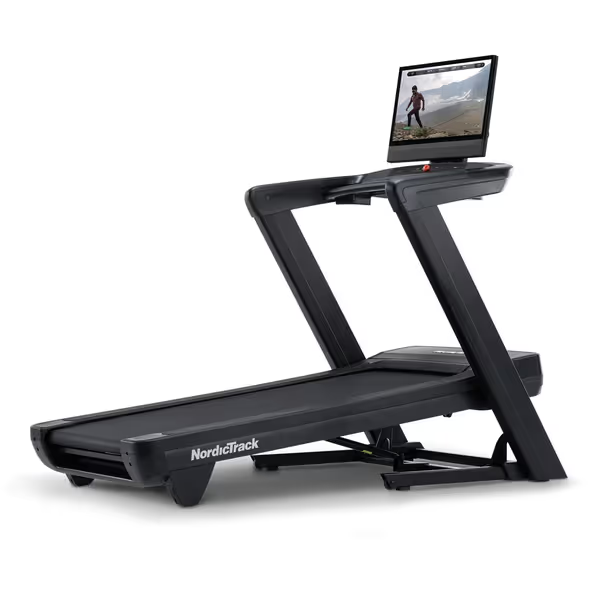
The real smart move? Choosing equipment with reliable wireless heart rate compatibility that works with proven chest strap technology. For platform ecosystems and ongoing subscription costs, see our iFit vs Peloton comparison. Take the NordicTrack Commercial Series. It seamlessly pairs with ANT+ and Bluetooth straps while providing the cushioning and stability needed for accurate readings during actual running.
I've debugged enough "smart" treadmills to know: Gimmicks rarely solve fundamental engineering limitations. A proper chest strap system integrated with reliable hardware beats any touch-based sensor for serious training.
Here's what most reviewers miss: Dust and sweat buildup directly impacts heart rate accuracy. I've seen perfectly functioning treadmills give wild readings because someone spilled a sports drink on the handrails six months earlier.
Your Monthly Heart Rate Sensor Maintenance:
This takes 5 minutes but prevents hundreds in potential frustration. For a full upkeep checklist and troubleshooting steps, read our treadmill maintenance manual. As I've told countless clients while fixing their machines: A maintained treadmill is safer, quieter, and far cheaper over time.
Based on thousands of service calls and client feedback, here's my honest advice:
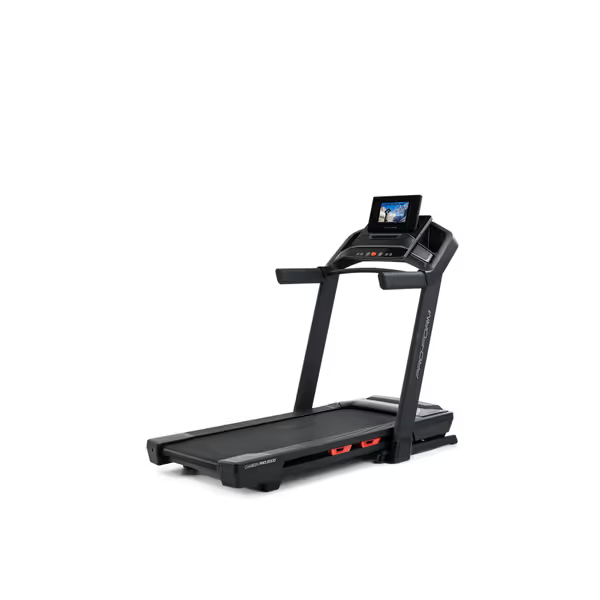
For casual walkers: Grip sensors work reasonably well if you follow the maintenance checklist. The ProForm Pro 2000 offers surprisingly reliable hand pulse monitoring for walking speeds with its responsive sensors.
For serious runners or cardiac patients: Only chest strap technology delivers the accuracy you need. Invest in a quality strap (Polar H10 is my top recommendation) and verify your treadmill has proper wireless compatibility.
For multi-user households: Consider a treadmill that supports both options. The NordicTrack Commercial Series accommodates grip sensors for quick checks while pairing seamlessly with chest straps for serious training, no subscription required for basic heart rate functionality.
Your heart rate data is only as good as your monitoring system. In my years as a mobile tech, I kept seeing the same autopsies: dry belts, misaligned rollers, dusty boards. Five minutes of lube beat five hundred dollars of parts. The same principle applies here. Investing in accurate heart rate monitoring prevents wasted workouts and potentially dangerous overexertion.
Whether you choose grip sensors for convenience or chest straps for precision, understand their limitations and maintain them properly. That's the real secret to longevity (both for your equipment and your fitness journey).
By focusing on what actually works, not what's marketed, you'll get consistent, reliable data that drives real results. Because when it comes to home fitness equipment, the smartest investment isn't the flashiest machine, it's the one that keeps working correctly, day after day.
Buy once, keep moving, knowing your heart rate data is accurate, your machine is properly maintained, and your workouts are actually working. Now that's a metric worth tracking.