Training, Technique & Workouts
Treadmill Chronic Fatigue Protocol: Pacing To Avoid PEM
21st May•10 min read

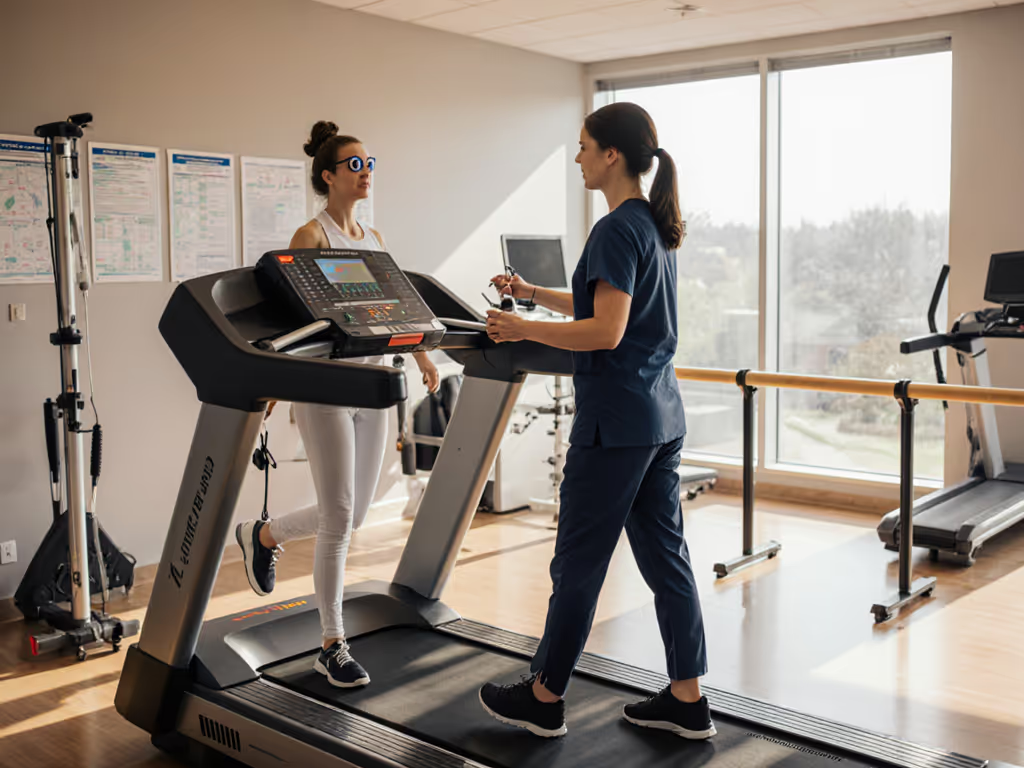
Treadmill vestibular rehabilitation combines targeted gait retraining with precise body mechanics to restore balance and confidence in individuals recovering from inner ear dysfunction, concussion, or balance disorders. Unlike generic treadmill walking, evidence-based vestibular protocols operate on a measurement-led principle: the machine, your stride, and your space must align perfectly to protect joints and ensure the consistency that recovery demands.
Your stride writes checks; the deck must cash them. This article outlines the proven framework for treadmill vestibular rehabilitation, and why fit matters as much as function.
The vestibular system governs balance, spatial orientation, and coordinated movement. When compromised (whether through labyrinthitis, Mal de Débarquement Syndrome (MdDS), post-concussion syndrome, or other conditions), even routine walking becomes cognitively exhausting and physically risky.
Traditional treadmill walking places the full weight of your body on the vestibular system while it processes compromised signals. A progressive treadmill protocol, however, uses body-weight unloading to allow the vestibular system to reset while movement is controlled and repeatable. For deeper clinical parameters and progression ideas, see our vestibular treadmill protocols. This isn't about avoiding load; it's about dosing it intelligently.
The science underlying this approach is vestibular adaptation: the brain's capacity to recalibrate sensory signals from the inner ear over time. By systematically altering gravitational load and introducing controlled challenges, therapists and patients can retrain neural pathways. The treadmill environment offers what overground walking cannot: consistency, measured progression, and the safety to fail small.
Effective vestibular rehabilitation on a treadmill follows a structured framework built on precise assessment and progressive dosing.
Before the first step, a thorough evaluation determines baseline balance, gait quality, and vestibular function. If you’re new to diagnostic setups, our treadmill gait analysis guide explains how to assess stride mechanics specific to belt running. This assessment identifies your natural stride length, cadence, and any asymmetries or compensations. Measurement is not optional; it's the foundation.
Key measurements include:
I learned this the hard way. A back-rail scrape during tempo work years ago taught me that deck dimensions aren't cosmetic; they determine whether movement is genuine or constrained. For vestibular patients, who already feel off-balance, a too-short deck adds psychological burden and neuromotor confusion. The machine's geometry either supports recovery or sabotages it.
The patient begins therapy with significant body-weight reduction, typically 40-60% unweighting or more, depending on tolerance and need. In advanced protocols, unweighting can exceed 50%, allowing the otolithic organs to rest while the brain remains engaged.
The progression follows a gentle, measurement-based increment:
This is adaptive progression, not arbitrary. Your body tells the story; measurement confirms it.
Once baseline comfort is established at reduced weight, gait training focuses on maintaining steady rhythm, proper postural alignment, and natural stride mechanics. The treadmill speed is held constant, which is a major advantage over overground walking, where pace becomes an additional cognitive load.
Critical gait parameters:
Vestibular recovery isn't confined to the treadmill. Skills learned during therapy must transfer to real-world scenarios: walking on variable surfaces, navigating obstacles, managing daily activities. This bridge phase typically begins when the patient regains confidence and demonstrates stable gait at or near body-weight.
Functional integration exercises include:
Your stride writes checks; the deck must cash them.
By this stage, the treadmill has done its job: it rebuilt the foundation. The real world now tests and reinforces that foundation.
This is where ergonomics matter beyond marketing. A treadmill used for vestibular rehabilitation must meet precise mechanical standards:
Protect your joints by ensuring the treadmill's mechanics preserve natural movement. The machine should disappear; only the movement should matter. Comfort and safety aren't luxuries; fit determines consistency and injury risk.
After 6 weeks of twice-weekly therapy, clinical improvements are measurable: reduced dizziness, improved balance scores, increased walking speed, and restored confidence. Patients often return to full duty (whether occupational or athletic) within 8-12 weeks, depending on baseline severity and consistency.
These outcomes depend on protocol adherence and equipment reliability. A treadmill that's noisy, inaccurate, or physically restrictive will undermine even the best clinical program.
Recovery from vestibular dysfunction is real, measurable, and achievable. The treadmill is a tool, a precise, body-aware tool. Match it to your body, your stride, and your space, and it will support the consistency that healing demands.