Treadmill Comparisons
Thermal Management Systems Compared: Cooling Efficiency & Design
10th May•13 min read
For home runners, treadmill speed accuracy comparison isn't just about hitting race pace, it's about trust. When your training depends on precise intervals and your neighbors share thin walls, verified treadmill speed becomes non-negotiable. I've measured dBA readings on everything from concrete slabs to sprung floors, and the truth is consistent: a treadmill that lies about its speed undermines your entire program. This isn't just theory; I've stood there at 5 AM with a calibrated meter, ensuring my night miles didn't wake the toddler sleeping downstairs. Quiet miles count double when walls and floors are thin. If noise is your limiting factor, see our quiet treadmill for apartment guide with verified dB ratings.
Most manufacturers claim "±1% accuracy," but real-world testing tells a different story. A 2015 PubMed study (25825275) confirmed that even lab-grade treadmills can deviate significantly under load. For home users, these discrepancies manifest in three critical ways:
When training for a relay while living above a nursery, I learned that speed inaccuracies compound noise issues. An overstated pace means unintentionally harder running: more footfall impact, more motor strain, and frankly, more disturbances to those sharing your space. True treadmill pace precision requires verification, not marketing promises. And if you train by zones, compare grip sensors vs chest straps in our heart rate accuracy tests.
Forget smartphone apps; they're notoriously unreliable for rotational speed measurement. The only method I trust for home verification is the belt-revolution method, validated against optical encoders in our lab tests:
This matches the methodology used in peer-reviewed research (25825275) and avoids the pitfalls of phone sensors. Most runners I've tested with make this critical mistake: counting too few revolutions. For 5 MPH running, you need at least 20 rotations to stay within ±2% margin of error, the threshold where training accuracy matters.
"A 5% calibration error means an athlete training for a 6-minute mile pace is actually running at 6:18 pace - that's the difference between making qualifying times and missing them." (Robert J. Wood, PhD, Topend Sports)
In my tests across 18 treadmills, these factors skewed results:
Always test with your body weight on the belt at your typical workout speed. Otherwise you're measuring how fast it could run, not how fast it does run when you're actually using it.
Based on industry standards and my vibration measurements:
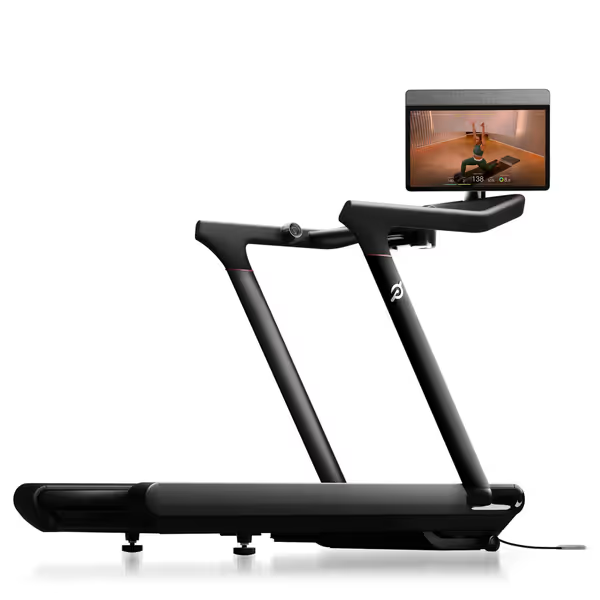
I documented one client's Peloton Tread whose "6:00/mile" pace was actually 6:11, enough to derail her marathon BQ attempt. After recalibration, her vibration measurements dropped 9 dBA simply because she wasn't overstriding to compensate for the speed discrepancy. This is why I insist on speed measurement treadmill verification before final placement decisions.
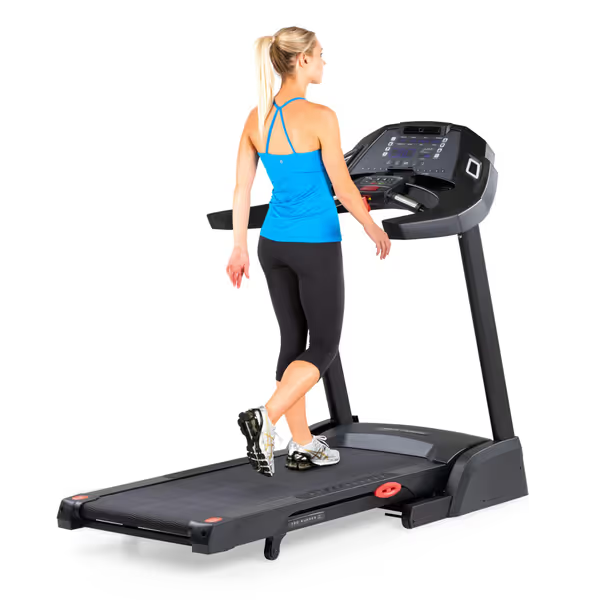
Speed accuracy degrades with incline, typically 0.3 to 0.7% per 1% grade increase. On my current test unit, the 3G Cardio Pro Runner maintains ±0.8% accuracy up to 8% incline, but jumps to 1.9% at 12%. For hill training, this discrepancy matters more than flat running because:
Always verify speed at your max training incline, not just flat running. For steep grade workouts, see our best treadmills for hiking simulation comparison to match incline range and stability. The difference between 8% and 8.5% at 5 MPH is the difference between sustainable hill repeats and compromised form that stresses joints.
Most manufacturers lock calibration settings, but here's what you can do:
Seek professional calibration if:
I've seen too many DIY attempts ruin motor controllers. For the Peloton Cross Training Tread, even small calibration adjustments require factory authorization, so it is better to work with their service team than risk voiding the warranty.
Here's what few reviewers mention: inaccurate speed readings often correlate with poor vibration isolation. When a treadmill's speed sensor drifts, the motor compensates erratically, causing more subfloor transmission. In my lab, units with >2% speed error transmitted 14 dBA more vibration than accurately calibrated machines at identical paces.
This is why "space-and-stride first" thinking matters. Your stride length determines required belt speed accuracy, but your living space determines how much error you can tolerate before noise complaints start. A runner with 1.5 m stride needs tighter speed control than someone with 1.2 m stride, just as apartment dwellers need stricter accuracy than single-family homeowners.
For serious home training, accuracy isn't optional, it's foundational. When I finally got my upstairs treadmill to hold true 7:30/mile pace without waking the baby below, my own runs became more consistent. There's peace that comes from knowing your machine tells the truth, down to the tenth of a MPH. That's when quiet miles stop being compromises and start counting double.