Treadmill Chronic Fatigue Protocol: Pacing To Avoid PEM
By Kai Moreno • 21st May
Treadmill Chronic Fatigue Protocol: FAQ Deep Dive
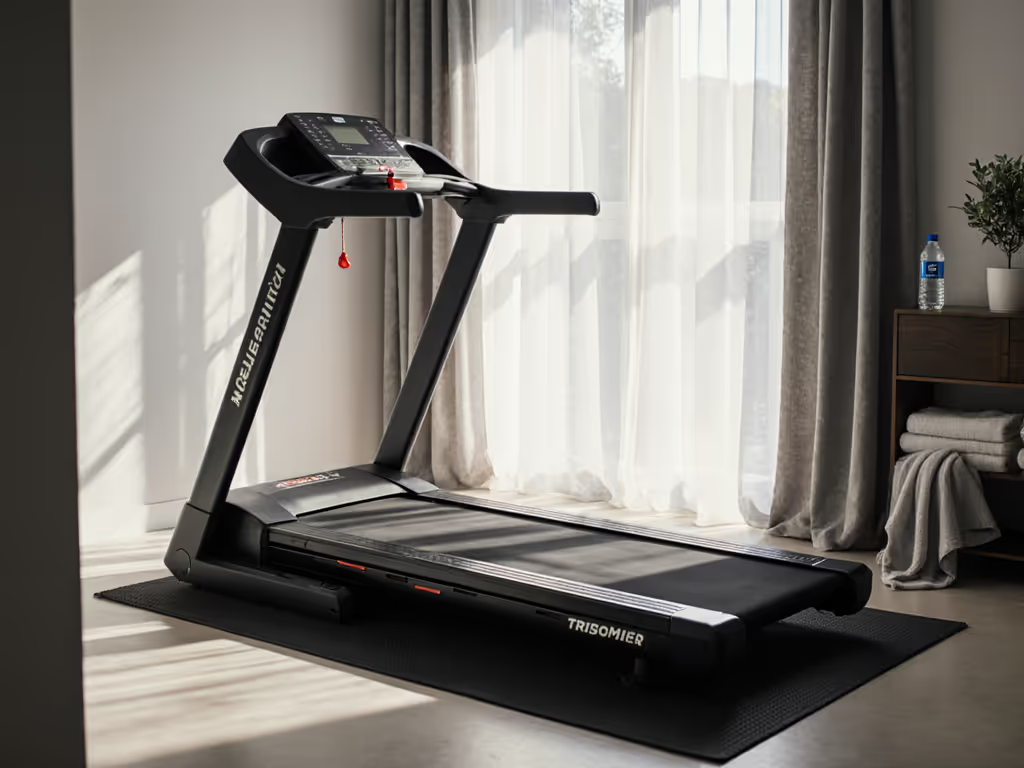
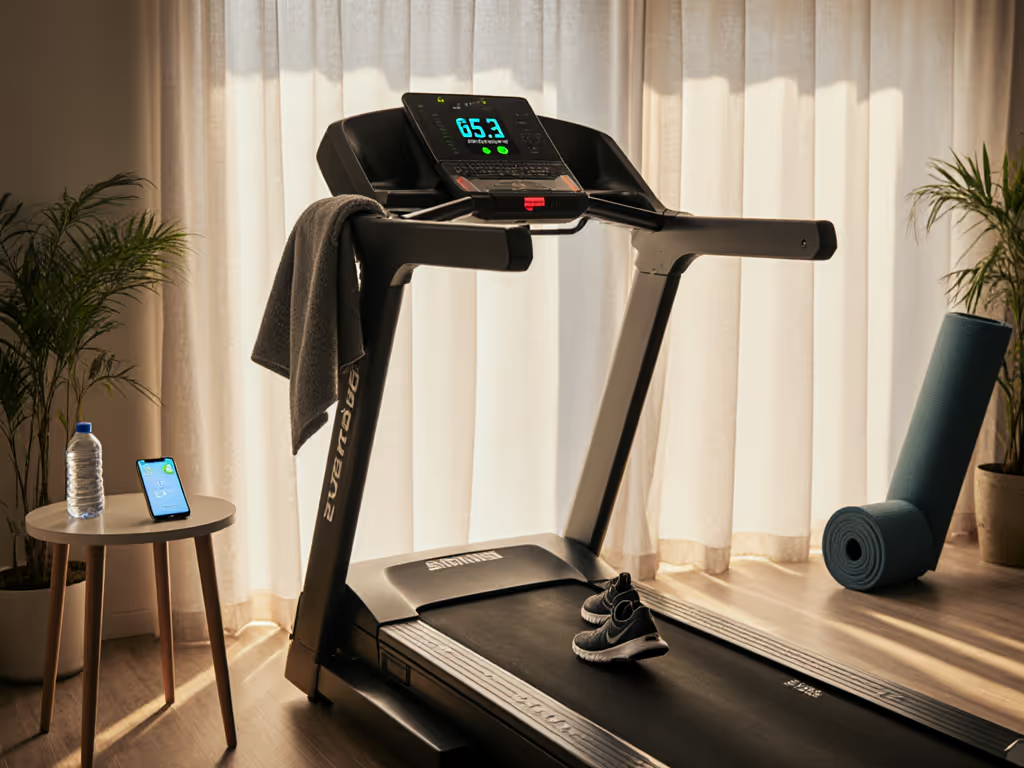
Living with ME/CFS means any movement plan has to protect you from post-exertional malaise (PEM), not chase fitness PRs. A treadmill chronic fatigue protocol isn't about "getting in shape." It is about using a precise, controllable tool to help you pace inside your energy envelope. When ME/CFS treadmill training is done at all, it needs to be sub-aerobic, symptom-led, and optional.
Standard exercise plans for healthy people can be harmful for people with ME/CFS.
NICE and CDC now both warn against traditional graded exercise therapy (GET) for ME/CFS after reviewing the data. The goal here is not to recreate GET on a treadmill, but to show how to use a treadmill (if you and your clinician decide it's appropriate) as a pacing instrument.

1. Is treadmill use safe with ME/CFS?
It depends on severity, stability, and medical guidance. Some people with ME/CFS cannot tolerate even minimal exercise without immediate worsening. Others, especially milder or improving cases, can sometimes use very gentle, very short treadmill bouts without triggering PEM.
Key points from current guidance:
- NICE (UK) no longer recommends GET for ME/CFS.
- CDC states clearly that exercise is not a cure and that vigorous aerobic exercise can be harmful.
- Both emphasize pacing, energy envelopes, and individualized limits.
So:
- Treadmill use is not required for recovery.
- Any treadmill work should be sub-aerobic and co-designed with your clinician or ME/CFS-literate therapist.
If a professional managing your care says "no structured exercise," that includes the treadmill. Before any trials, review these treadmill safety tips to reduce fall risk and avoid unnecessary startle or overexertion.
2. What is PEM, in treadmill terms?
PEM is a delayed worsening of symptoms after exertion that would be trivial for a healthy person. With a treadmill, PEM can be triggered not just by speed, but by:
- Session duration (even at 1-2 km/h / 0.6-1.2 mph)
- Standing time
- Heat and poor ventilation
- Cognitive load (multitasking, screens)
For many, the "post-exertional malaise treadmill" trap looks like this:
- You feel slightly better and walk longer or faster.
- You feel okay during and right after.
- 24-72 hours later, fatigue, pain, brain fog, or flu-like symptoms spike.
Success on a treadmill with ME/CFS is defined very bluntly:
A "good" session is one that does not provoke PEM in the following 2-3 days. If you're recovering from COVID-19 or experiencing post-viral fatigue, see our post-COVID treadmill recovery protocols for symptom-led pacing.
Everything else is secondary.
3. Why does treadmill accuracy matter so much here?
Because your margin for error is small.
In ME/CFS, the line between "tolerable" and "relapse" can be a few heartbeats per minute or a small speed change. Lab tests show that many home treadmills can misreport speed by 3-8%, especially at lower speeds and under load. If you think you're walking 1.5 mph, but you're actually at 1.8 mph plus a bit of incline, your metabolic load may be far higher than planned.
I learned the hard way that consoles lie. I now use cheap optical tachometers and belt markers in testing. Speed is a promise; we verify it, millimeter by millimeter. For ME/CFS, that precision is not about performance; it's about safety.
If you'll use the treadmill for pacing:
- Favor machines with fine low-speed control (0.1 mph / 0.1 km/h steps).
- Avoid models that "jump" when you change speed.
- If possible, validate speed once (with a technician, app, or simple marker-counting method).
A stable, predictable deck is easier on your nervous system than a wobbly, surging one.
4. How slow is "slow enough" on the treadmill?
There is no one number, but "sub-aerobic" is the key idea.
Common clinician-used starting reference points (not rules):
- Keep heart rate below ~60% of age-predicted max, or
- Keep heart rate under resting + 15-30 bpm, and
- Stay at a perceived exertion of 3-4 out of 10 or less.
These are just frameworks. ME/CFS responses vary widely:
- Some people hit their limit at standing.
- Others tolerate very slow walking (e.g., 1-2 mph / 1.6-3.2 km/h) for short periods.
The practical approach:
- Work with your clinician to define a heart-rate ceiling or symptom threshold.
- Set the treadmill speed so you stay well below that ceiling.
- Be ready to reduce speed further if you see drift upward during the session.
If you can't monitor heart rate, your safety margin should be even larger. To choose reliable sensors, compare treadmill heart rate accuracy.
5. What are "micro-workout treadmill routines" for chronic fatigue?
For ME/CFS, micro-workouts are tiny, separated bouts of gentle movement rather than one continuous session.
On a treadmill, that can mean:
- 30-90 seconds of very slow walking
- Once every few hours
- With lots of rest, lying down if needed, between bouts
Why micro-bouts help:
- They limit immediate metabolic strain.
- They give you multiple chances to check in with symptoms.
- They can support circulation without demanding true "exercise."
This is what pacing treadmill for chronic fatigue really means: using the machine as a controlled, repeatable way to sprinkle in tiny movements, not as a tool to reach step goals at any cost.
Your body, not the console, decides how many micro-bouts are appropriate on a given day.
6. What does a cautious treadmill chronic fatigue protocol look like?
Because of my "no training plans" rule and the complexity of ME/CFS, I won't give a step-by-step schedule. Instead, here's a framework to discuss with your clinician.
Think of it as a monitoring protocol:
-
Establish a baseline day.
- What can you do now, without PEM in the next 48-72 hours?
- That might be "no treadmill," and that's okay.
-
Define the smallest test bout.
- For some, it's standing on the treadmill for 30-60 seconds.
- For others, it may be 30-60 seconds of very slow walking.
-
Set a strict ceiling per day. Examples: 2-5 minutes total, split into micro-bouts. The exact number must be individualized.
-
Hold the line for weeks.
- No automatic progression.
- Repeat the same minimal dose several times over 2-3 weeks with careful symptom tracking.
-
Only consider tiny increases when:
- You've had zero PEM at that dose for several weeks.
- Daily life activity is stable or improving.
- You and your clinician agree it's reasonable.
-
Progress by 5-10% at most. That could mean adding seconds, not minutes. Or adding one extra micro-bout on your best day, then re-observing for 1-2 weeks.
-
Immediately step back if symptoms worsen.
- Go below the last clearly tolerable level.
- Stay there until things stabilize again.
This is what a treadmill for energy management looks like: conservative, reversible, and always subordinate to your overall function.
7. How do I spot overdoing it early?
Watch for in-session warning signs:
- Sudden heaviness or "jelly legs"
- Dizziness, nausea, or air hunger at very low workloads
- Rapid heart rate jumps or pounding at slow speeds
And post-session warning signs in the next 24-72 hours:
- Marked increase in fatigue or "crash" feelings
- New or worsened pain, sleep disturbance, or flu-like symptoms
- Cognitive decline: word-finding issues, unreadable screens, confusion
If any of these occur after using the treadmill, treat that session dose as too high. Future bouts should be shortened, slowed, or paused entirely.
A simple log helps:
- Time, speed, and incline
- Heart rate (if monitored)
- Symptoms during, 24 hours later, and 48 hours later
Patterns matter more than any single session.
8. What treadmill features matter for ME/CFS?
Because intensity must be low and precise, the usual "top speed / max incline" arms race doesn't apply. Instead, for ME/CFS treadmill training prioritize:
-
Low-speed control and accuracy
- Speeds down to 0.3-0.5 mph (0.5-0.8 km/h) are valuable.
- Fine increments (0.1 mph / 0.1 km/h) make dialing in sub-threshold work easier.
-
Stable, low-vibration deck
- Minimal wobble reduces extra muscular bracing.
- Deck stability matters even at walking speeds.
-
Gentle start/stop behavior
- Smooth acceleration to avoid sudden load spikes.
- Instant but controlled stop via safety key.
-
Accurate, low incline range
- Even 1-2% error can change your true effort.
- For many with ME/CFS, 0% incline is the default.
-
Clear, simple console
- Large numbers, minimal clutter.
- Easy to see speed and time without cognitive strain.
-
Heart rate connectivity (optional but helpful)
- Chest strap or optical armband support.
- So you can enforce your agreed-upon heart rate ceiling.
-
Low noise
- Lets you walk at odd hours without disturbing others.
- Reduces sensory overload during use. If noise or neighbors are a concern, see our quiet treadmill for apartments guide with verified dB data.
If you're a "buy once" person, this is where you invest: in precise control, quiet stability, and predictable behavior rather than streaming screens. My bias is clear: buy once, keep moving, at your pace.
9. Should I use incline instead of speed?
For healthy runners, a 1% incline can mimic outdoor wind resistance. For ME/CFS, small inclines can sharply increase heart rate and load.
In most chronic fatigue contexts:
- Start at 0% incline by default.
- Only consider 1-2% incline if:
- Flat walking at very low speed is consistently tolerable, and
- Your clinician agrees it fits your pacing plan.
If you add incline at all, treat it like increasing speed: a 5-10% change in total load at most, followed by weeks of re-assessment.
Flat and safe beats "more intense" every time.
10. How do I adjust for good and bad days?
People with ME/CFS often talk about a "volume dial," not a light switch. The treadmill needs to follow that logic.
Principles:
- Define a baseline dose that is usually tolerable.
- On worse days, reduce that dose, sometimes to zero.
- On better days, any increase should still be modest.
A common approach is to keep day-to-day changes within about ±20-30% of your established baseline volume and to avoid stringing together multiple "high" days.
If you think, "I feel great, I'll double it," that is usually the moment to back off instead.
Summary and final verdict
Using a treadmill with ME/CFS is less about fitness and more about measurement.
A well-chosen machine can offer:
- Stable, predictable low speeds
- Accurate speed and incline, so tiny changes are intentional
- Quiet operation that lets you schedule micro-bouts when your body allows
But the treadmill chronic fatigue protocol is fundamentally a pacing protocol:
- Sub-aerobic, symptom-led effort
- Micro-workout treadmill routines instead of continuous exercise
- No automatic progression; every increase is earned by weeks without PEM
If you and your clinician decide that gentle ME/CFS treadmill training fits your situation, treat the treadmill as calibrated lab equipment, not a motivational coach. Keep loads low, changes small, and watch the 24-72 hour window more than the console.
The machine's job is simple: do exactly what you tell it, no more. Your job is harder: listening when your body says "that's enough," even when the numbers look tiny. If your treadmill helps you respect that boundary, it's done its part.
Everything else is bonus.
Related Articles

Training, Technique & Workouts
Treadmill Vestibular Rehabilitation: Proven Protocols
20th Apr•7 min read
Training, Technique & Workouts
Treadmill Vestibular Rehabilitation: Evidence-Based Protocols
31st Mar•8 min read

Training, Technique & Workouts
Marathon on Treadmill: Protocols for Your First 26.2
23rd Mar•7 min read