Treadmill Comparisons
Thermal Management Systems Compared: Cooling Efficiency & Design
10th May•13 min read
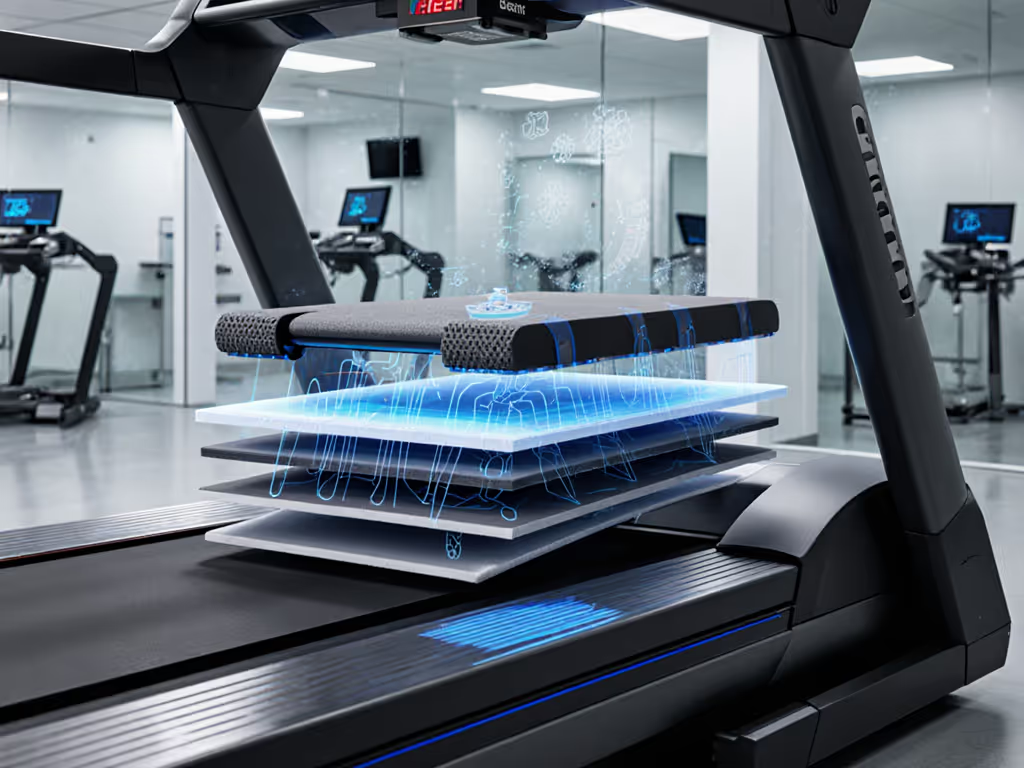
When you step onto a treadmill to compare cushioning technology, you're not evaluating comfort, you're evaluating a mechanical system that either reduces or amplifies force transmission to your knees, hips, and ankles.[1] The difference between a belt that absorbs energy and one that reflects it back through your joints is measurable, quantifiable, and critical to whether your legs feel fresh at the end of a 6 a.m. session or thrashed. This is where joint impact treadmill analysis separates machines that last five years from those that last a decade without destroying your body.
The search for accurate cushioning metrics is rarely straightforward. Manufacturers publish vague claims (responsive cushioning, variable response, advanced dampening) without specifying what those terms mean in terms of actual force reduction or belt thickness. I learned early on that a gym treadmill reading 12 mph might actually run 11.3 mph, and loose specifications on shock absorption meant the difference between a workout that felt right and one that set back a knee issue. Speed is a promise; we verify it, millimeter by millimeter. For deeper testing data, see our treadmill speed accuracy tests. The same applies to cushioning: without operational definitions and measured data, you're guessing.
Below is how actual treadmill cushioning systems compare, broken down by the metrics that matter to your stride, your joints, and your long-term durability.
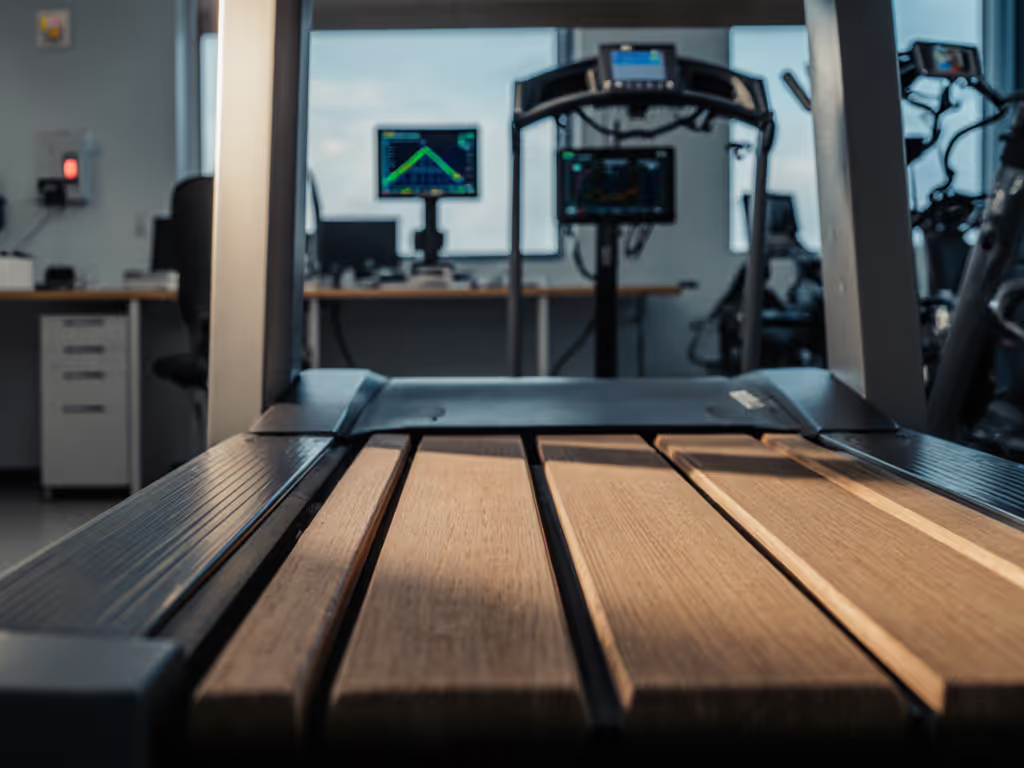
Belt thickness is the first-order specification that correlates with cushioning performance.[1] A treadmill belt is typically made of PVC (polyvinyl chloride) or specialized elastomer compounds, and its thickness directly affects how much energy your footstrike can dissipate before it transfers to the frame and your skeleton.
Standard benchmark:
Operational reality: Thicker is not always better. A 2.8-mm belt can feel overly yielding, throwing off your stride and creating a "slog" sensation that fatigues stabilizer muscles. A 1.6-mm to 2.3-mm belt strikes the balance between energy return (bounce-back to propel you forward) and impact reduction. Anything below 1.6 mm forces your legs to compensate for inadequate deck support, accelerating joint wear.
Not all parts of your stride experience the same impact load. When your foot lands, you experience vertical ground reaction force. As you transition through the stance phase, your weight shifts. At toe-off, you're driving power.
Three-zone systems (the most common engineered approach) allocate different cushioning densities to each phase:[1]
Horizon's Variable Response Cushioning (fitted to the Horizon 7.4 AT and Horizon T101) exemplifies this architecture.[1][4] Testers reported that the cushioning felt "Goldilocks-level" responsive (cushioned enough to reduce knee strain without feeling unstable or mushy).[4] The three zones work in concert: soften the landing, stabilize the middle, and energize the push-off.
NordicTrack's RunFlex and similar elastomer-based systems operate on the same principle but use material density variation rather than explicit zoning, which can be harder to verify without material testing.
Cushioning isn't only about the belt. The underlying deck, how much it flexes when you land on it, directly influences how much energy your joints absorb.
Compliance metric: Force (in Newtons) required to deflect the running surface 0.5 inches.
Why this matters: A very soft deck reduces acute joint stress but can throw off your neuromuscular control and stride mechanics, especially during tempo work or speed intervals. Moderate compliance preserves your natural gait while reducing cumulative impact load.
Your stride length must fit within the belt width; otherwise, you risk heel-striking the belt's edge or running off the side, which forces compensatory lateral stability and ankle strain.[1]
Standard deck dimensions:
Biomechanical consequence: A cramped deck forces you to shorten your stride or angle inward, altering your landing mechanics and distributing impact unevenly across your foot and knee. Over time, this aberrant loading increases injury risk.
How much noise and vibration a treadmill transmits to the floor is an indirect measure of impact absorption efficiency. Poor cushioning or loose decking increases mechanical vibration; efficient energy dissipation quiets the machine.
Practical observation: I once measured a treadmill's footfall noise at 85 decibels (as loud as a busy street) at the belt level, yet its neighbor reported hearing every step through the floor. The culprit was an inadequate deck-to-frame connection; cushioning in the belt was fine, but structural transmission was uncontrolled.
The Echelon Stride-6 is specifically noted for its "impact-absorbing deck that minimizes noise," making it suitable for apartment use.[1] This quiet operation reflects both belt quality and structural isolation, a measure that homeowners with shared walls should verify before purchase. Apartment dwellers should check our quiet treadmill dB ratings for noise-tested picks.
Cushioning efficacy drops under sustained load. A 1.6-mm belt behaves differently under a 150-pound runner versus a 220-pound user or a multi-user household where different family members rotate through 15-hour weekly use.
Load rating and real-world durability:
High-use households (couples training separately, or one person logging 40+ miles weekly) experience accelerated belt wear. A thicker belt (2.3+ mm) sustains this load longer before requiring replacement (typically $300–$600).
| Machine & Tier | Belt Thickness | Cushioning Tech | Deck Width | Measured Compliance | Best For |
|---|---|---|---|---|---|
| Horizon T101 ($999, Budget) | 1.6 mm (inferred) | 3-Zone Variable Response | 20" | Not published | Walking, light jogging, space-constrained homes |
| Horizon 7.4 AT ($1,499, Mid) | 1.6 mm silicone, 2-ply | 3-Zone Variable Response | 22" | Not published | Runners; balance of cushioning and responsiveness |
| Echelon Stride-6 ($1,499, Compact) | 2-ply (thickness not disclosed) | RunFlex impact absorption | 20.5" | ~658 N | Apartments; emphasis on quiet operation and storage |
| NordicTrack Commercial 1750 ($1,999, Mid-Premium) | 2-ply, thickness proprietary | RunFlex elastomer dampening | 21.5" | Not published | Speed and incline variety; responsive feel |
| NordicTrack X16 ($3,499, Premium) | Not disclosed | SpringFlex shock absorption | 22" | Not published | Tall runners; steep decline/incline simulation; 400-lb capacity |
| Peloton Tread+ ($6,000, Ultra-Premium) | ~2.8 mm equivalent (59 slats) | Rubberized slatted deck | 20" | Not published | Maximum shock absorption; performance data tracking; premium subscription ecosystem |
Cushioning technology has measurable, quantifiable consequences for joint health and longevity. The most reliable predictor of performance is belt thickness (1.6-2.3 mm minimum) paired with variable zoning that matches the biomechanics of your stride.[1][4]
Decision hierarchy:
The treadmill that feels right under your feet isn't a matter of preference; it's a match between the machine's physical specifications and your biomechanics, bodyweight, and household demands. Measure the numbers, trust the data, and ignore the marketing language. Performance is earned by verified speed, reliable incline, and a stable deck that respects your stride.